
Creating Accessibility Guidelines
My process for translating the current, 2025, industry standards for accessibility design in games to create student-level accessibility guidelines.
If you want to see real progress in your industry, a great start is to support your students; your future.

Why?
Throughout my experience as a student, I haven’t been able to implement accessibility features. This is due to various reasons, but the main one is that I had to spend most of my time researching these features. My only real resource was the internet, meaning I had to personally sort through everything and translate whatever I found into something suitable for a student game.
While I am glad that I got to learn so much about something I care so much about, I decided to make a resource that would benefit future students. I want future teams to get some real experience with designing through an accessibility lens, without the pressure to spend so many hours researching.
Client Meetings
Early in this process, I sought to answer the question, “who is my client?”. It couldn’t be my specific school, as that would make this resource less modular than I would like. While I want to help students, I felt that making students themselves the ‘client’ might create issues with distribution and might make things a little too broad. I ultimately decided to make teachers my target demographic as I wanted this resource to be something that could either be directly handed to students or integrated into project courses.
To make sure that I knew my client’s needs I ended up sending some questions to my school’s project professors and did a few interviews. While I have plenty of experience on the other side of project courses, I wanted to ensure that this resource could be easily integrated into current and future project courses.
Research
Once I had planned out what I really wanted this resource to be, it was time for research! I found many websites and blogs that I found useful on this journey; most of these are listed at the end of the document to allow readers to explore these topics further. I wanted to focus on real human experiences, and not just look at guidelines that may be based on third or fourth-hand information. The big thing that I was missing though, was real human expertise.
Professional Consultants
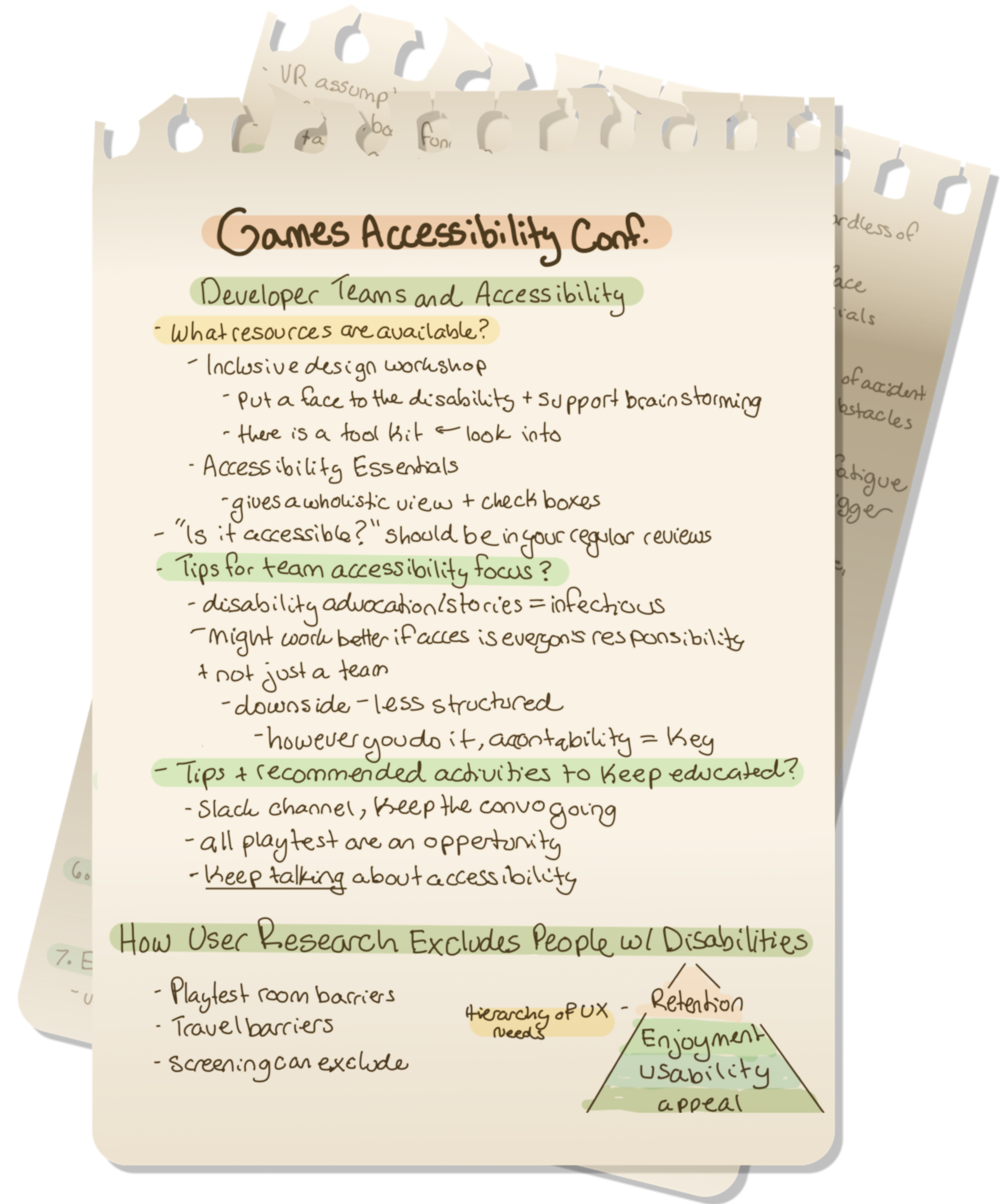
I am incredibly lucky that while I was going through my independent study and creating this resource, GAConf was going on. I was able to watch many talks that helped support me in this process, but I also ended up meeting multiple industry professionals who volunteered themselves to be consultants on this project. I used these connections, as well as others from previous connections, to have five people assist me. This entailed an interview, and occasionally follow up questions.
Writing and Editing
Now that I had done all of this research, the hard part really started. This resource went through multiple iterative states, all broken up by peer feedback and editing. One thing that I found out during this process is that trying to write an instructional document for a broad audience is very challenging. I kept wanting to add tangents or use more technical language, but I had to edit that down to make a more accessible document.

I am incredibly grateful for the chance I was given to create this resource. Of course, there are many things that I would like to change about it, but I was able to meet so many wonderful people in this industry, spend hours learning about my special interest, and work with a wonderful professor, Suzannah Calvery, PhD.
